On a mission to move preschoolers · Ages 3–6

Move Well.
Grow Well.

India's only dedicated early years Physical Literacy program of its kind. We don't just get children moving — we measure and grow their physical literacy through a research-backed development framework.

Watch a child who moves well. They stand taller, try sooner, and make friends faster. That confidence is built through movement based play, every single day. Motto Moto helps your teachers build it, in every child, at your school.

Aligned with NEP 2020 Your teachers, trained by us Child-wise progression tracking
“

Physical literacy isn't a subject a child studies. It's the confidence, control and comfort in their own body that everything else — sitting, listening, writing, playing well with others — gets built on top of.

— The idea at the center of this program

90%
of a child's brain develops by age 5 — movement is a key driver
Harvard Center on the Developing Child
180 min
of daily physical activity recommended for every young child
World Health Organization
80%+
of adolescents worldwide are not active enough — habits form far earlier
WHO / The Lancet
3–7 yrs
the golden window when fundamental movement skills are easiest to build
Motor development research
Our Philosophy

Time to be Proactive — not Reactive.

Most of us wait for a problem to appear — low fitness, low confidence, a delayed milestone — and then rush to fix it. Motto Moto flips that. We build strength, skill, and confidence before the gap can ever open.

The Reactive World

  • Wait for a concern, then look for a fix
  • Physical activity treated as a "break" from learning
  • Children made to move — without understanding or enjoying why
  • Movement gaps noticed only when they're big
  • Intervention starts late — when it's hardest
  • Screen time quietly fills the gap

The Motto Moto Way

  • Build fundamental movement skills, from age 3
  • Movement designed as brain-building, not time-pass
  • Children who understand their bodies — and want to move, from within
  • Every child observed and tracked, every term
  • Early signals spotted early — when support works best
  • Joyful, active habits that crowd out the screen
The window doesn't wait.

Fundamental movement skills — running, balancing, throwing, catching — are built most easily between ages 3 and 7. After that, the same skills take far more effort to learn.

BirthAge 3 — Golden Window — Age 7Adulthood
The Early Years

Where movement becomes learning

Between ages 3 and 6, the brain and body grow faster than at any other time in life. Every hop, climb, and catch is quietly building the child's future:

  • Balancing on one foot → builds focus & body control
  • Catching a ball → builds watching, waiting, responding
  • Climbing → builds confidence, courage & problem-solving
  • Group games → build listening, turn-taking, friendship
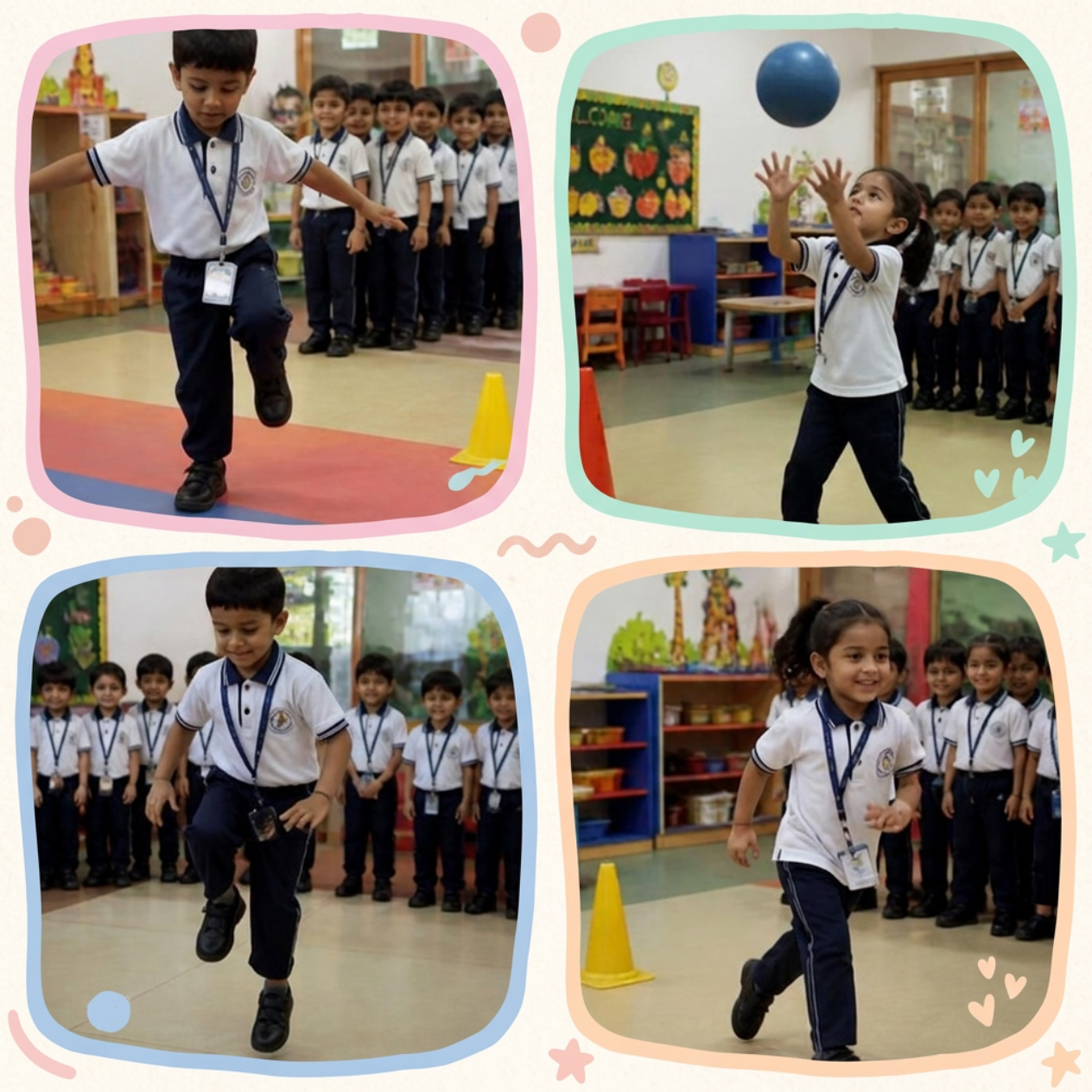
Preschoolers practising balance, catching and running skills
Every jump is a lesson. Every catch is a milestone.
Our Delivery Model

We train your teachers — not send ours

Your teachers know your children — who needs a gentle nudge, who needs a warm hug. A visiting coach once a week can never replace that bond. So we do it differently:

  • Movement happens every day — because the trained teacher is always there
  • Children feel safe learning from a familiar, loving face
  • The capability stays with your school — and grows year after year
  • Teachers grow too — new skills, fresh energy, deeper insight into each child
  • We stay with you — training, lesson plans, refreshers & ongoing support
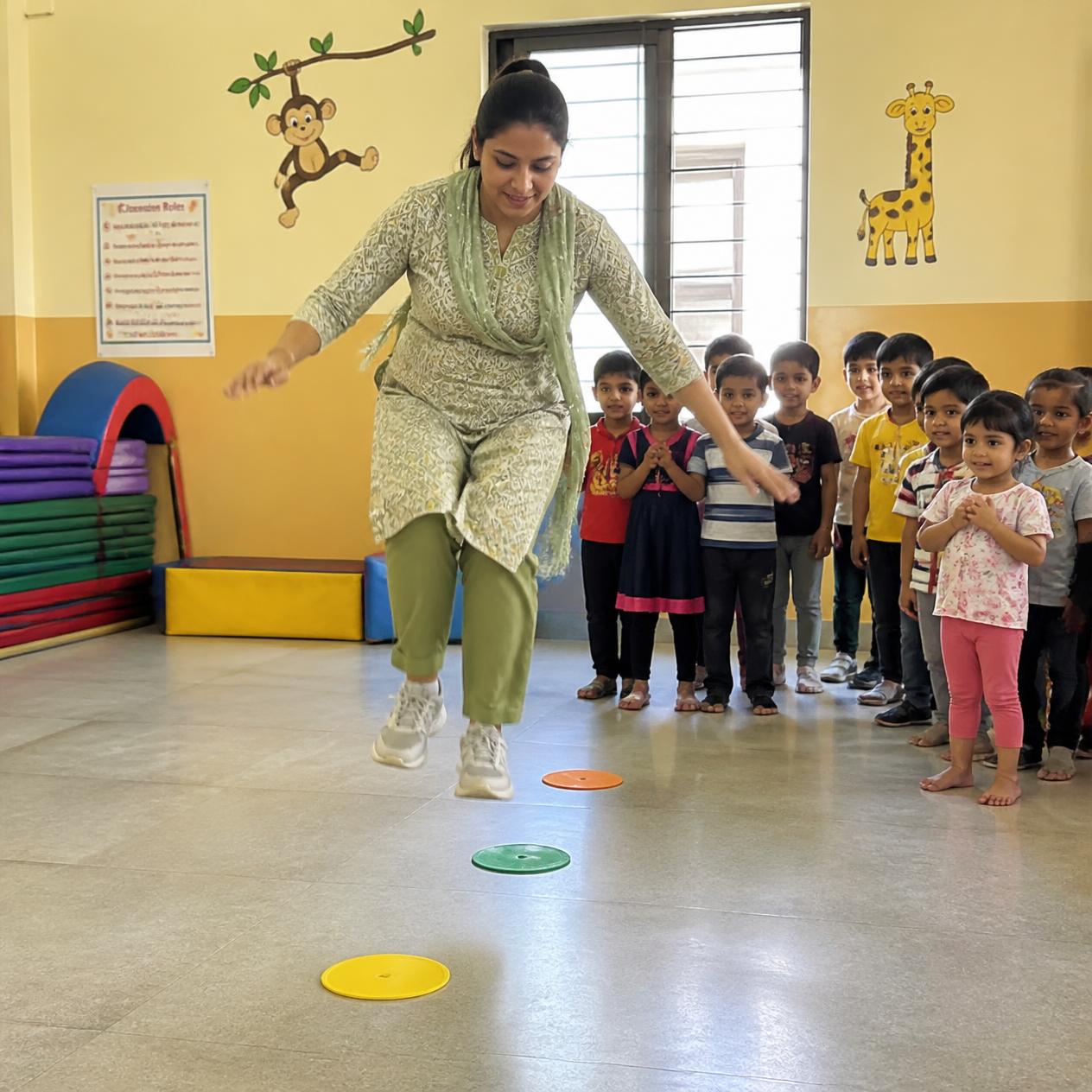
Teacher leading preschoolers through a jumping and coordination activity
The magic happens through your people — as it should.
Progression Tracking

A 3-Year Developmental Record, Not a Term Report

Every child is gently observed and celebrated as they grow across movement milestones. Why it matters so much:

Helping educators ensure no child goes unnoticed.

Policy Aligned

In step with the nation's vision

India's education landscape has embraced what we've always believed: the foundational years matter most. Motto Moto keeps your school aligned — and a step ahead.

NEP 2020

National Education Policy

Places the foundational stage (ages 3–8) at the heart of education — with play, movement, and physical development as core pillars, not extras.

NCF-FS

Curriculum Framework for the Foundational Stage

Explicitly names physical development and learning through play as essential domains for every young child.

Why "Motto Moto"?

Motto means mission. Moto means movement. Our name is our promise — we are, quite literally, on a Mission of Movement for every preschooler.

From the Founder

Why I started Motto Moto

"I didn't start in child development — my degree is in computer applications. It was motherhood that changed my direction. In my search for a class that would get my firstborn active, I found my true calling on the floor of an early years sports program. Observing my son grow alongside the program, I became curious about how little bodies learn.

Fourteen years of working closely with preschoolers taught me loud and clear: movement transforms childhood. The shy child finds her voice in a group game. The restless one finds his focus on a balance beam. Once you've seen that change, you can't unsee it. And once a parent thanks you for what it's done for their child, you can't stop spreading it.

I consider myself physically literate, because I choose being active every day. I still trek, still play, still say yes every time — my mother built that love of movement in me early. Motto Moto exists so every child gets the same gift.

Here's how we do it: every child gets to participate, wherever they're starting from. We break each skill into small, winnable steps — so a child practises, succeeds, and reaches for the next one, always able to see the goal ahead. Our teachers walk beside them as guides, observers and cheerleaders, not drill instructors. And when a child achieves something real with their own body, something quietly wonderful happens to how they see themselves.

All of it is my answer to one question — how do we make purposeful play part of every child's routine? Not to create athletes, but to build motor skills, confidence, joy, and habits that last a lifetime. I'd be honoured to build them at your school."

Neelakshi Khurana

Founder, Motto Moto

14+ years in early years sports programs Certified · Motor Skill Learning Academy, Switzerland Trainer of coaches & teachers Physically literate by choice · Mom of two
The Motto Moto Way

The difference isn't what we do.
It's how we do it.

Many programs teach children to run and jump. So do we. But at Motto Moto —

Every activity is designed with the child's brain in mind — not just the body.

Every session is delivered by someone who loves your children — their own teacher.

Every child is seen, tracked, and celebrated as an individual — no one slips through.

Every school becomes stronger and more capable — not more dependent.

Same movements. Completely different experience.

From Our Academy Floor

Today's parents are already asking for this

From years of running our own academy, we've seen a beautiful shift. Young parents don't just ask about ABCs anymore. They ask:

“My child gives up so quickly. How do I change that?”
“Is my child active enough?”
“There's too much screen time at home. What can we do?”
“My child won't sit still — is that a problem, or a good thing?”
“How do I prepare my child for sports later?”
“My child is shy in groups. Will they come out of their shell?”

When parents see structured, joyful physical development in a school — they notice, they talk, they choose that school, and they stay. Physical literacy is one of the warmest, most genuine ways for your school to stand out.

And it isn't just parents. Forward-thinking schools are already bringing physical literacy into their core curriculum conversations — the question is no longer whether to act, but who acts first.

Holistic Development

One game. Four kinds of growth.

Watch children play a simple movement game and you'll see everything happening at once. No worksheet can do all of this together. Play can.

Body

  • Strength & stamina
  • Balance & posture
  • Coordination

Mind

  • Listening, focusing & memory
  • Following rules
  • Problem-solving
  • Planning their moves

Heart

  • Taking turns
  • Cheering for friends
  • Handling wins & losses
  • Persevering at tricky tasks

Words

  • Following instructions
  • Expressing themselves
  • Celebrating out loud

The quiet result of it all: children who happily participate, stick with challenges, and grow in self-esteem and confidence — game after game.

Physical play isn't a break from learning — it is learning, in its most natural, joyful form.

The Long View

Picture them at thirty

Physically literate children grow into adults who take the stairs without thinking, say yes to the trek, and carry themselves with quiet confidence. Research shows they are:

Healthier

Lower risk of lifestyle-related illness across their lifetime

More Confident

Comfortable and capable in their own bodies

Better Learners

Movement and thinking grow together in the brain

Happier

Active people sleep better, stress less, and feel better

Physical literacy isn't about creating athletes. It's about creating adults who love being alive in their bodies.

Before You Ask

The questions coordinators ask us most

Bringing something new into a school always raises a few practical questions. Here are the honest answers to the ones we hear most.

Is this an expensive add-on for our school?+
Think of it less as a cost and more as one of the clearest ways to stand out to today's parents. Because we train your existing teachers rather than sending outside coaches, you're not paying for a person to visit every week — you're building a capability that stays with your school for good. Plans are tailored to your school's size and setup, and we'll walk you through the numbers openly in your demo.
Will this add to our teachers' already full workload?+
Our goal is to make your teachers' days easier, not heavier. We give them ready-to-use lesson plans, hands-on training, and simple routines that fit into the day they already run — movement woven into circle time and transitions, not bolted on as extra work. Most teachers tell us it brings fresh energy to their classroom, and channels restless energy in ways that make the rest of the day calmer.
Is it safe for children as young as three?+
Safety sits at the heart of the design. Every activity is age-appropriate and built around natural movements young children are ready for — balancing, hopping, catching — with no risky equipment or pressure to perform. Skills are broken into small, achievable steps so children are always working within their ability, and your own teachers, who know each child, are the ones guiding them.
We don't have a big playground or fancy equipment. Does that matter?+
Not at all. The program is designed for real schools — a classroom cleared of chairs, a corridor, a small open area all work perfectly. It uses simple, low-cost equipment that we will provide, and we'll help you make the most of whatever space you have. Physical literacy is about how children move, not how much equipment you own.
How does this fit with our existing curriculum?+
It complements what you already do rather than replacing anything. Physical literacy supports the same goals you're working toward — focus, confidence, listening, social skills — and aligns directly with NEP 2020 and the NCF for the Foundational Stage, so it strengthens your curriculum story rather than competing with it.

See the joy for yourself

The best way to understand Motto Moto is to watch it happen — children moving, teachers glowing, the room full of energy.

Be proactive. Start now, while the window is wide open.

* Required fields

Thank you! We've received your request and will reach out shortly.

info@mottomoto.in  ·  Vadodara